The following is a piece that I swiped from my “Perspectives” page. I wrote it as a thought exercise to help me process the impact of technological advances on the five generations currently living. As we’re about to say goodbye to the first quarter of the 21th century, the words seem more relevant than when the impetus to write them first struck, which was not that long ago.
The Age of Anxiety
by
Michael DeStefano
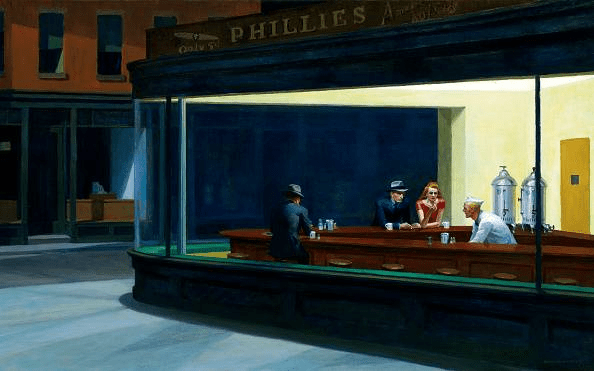
A Not So Unintended Consequence
When one is compelled to tote a heavy load, one of two things will typically happen: The bearer of the burden will develop such fiber and strength that they no longer notice the weight, or the weight will become burdensome to the point of hastening a collapse.
The heaviest burdens tend to be invisible—shapeless albatrosses that are adept at lurking in shadow, tricksters that manage to squeeze themselves into tight spaces and layers we would never think to look. Worse, their craftiness yields vulnerability that goes undetected until one is wholly consumed and has become a mental and emotional cripple, or numb.
Indeed, you guessed it: the burdens or afflictions I’m alluding to are anxiety and depression. So why have I chosen to broach such a “sunny” topic during the bleakest season (winter)? In my humble opinion, anxiety and depression (particularly anxiety) have surpassed being a contagion and have become normalized. Moreover, why we’re burdened with the thrust of anxiety may not be for the reasons we suspect. From a ten-thousand-foot view, one might be quick to cite the typical unrest many experience over race, gender, politics, and intermural culture wars; otherwise, the handy ensemble we seek to blame when we’re too lazy or frightened to look beyond the ends of our noses. But what if we ignored the low-hanging fruit and dug a little deeper? What might we find?
The Water They Forgot To Chart
Clinical psychologists have measured generational behavior and observed a decline in happiness and an uptick in negative emotions such as anxiety. For example, those of the Silent Generation are far less anxiety-laden than Zoomers; Boomers, on aggregate, are happier than Millennials; Gen Xers, the middle child in this scenario, are fluid and, depending on the stressor, could go either way.
What made the Silent Generation so darn happy? Weren’t they born into the Great Depression and then sent off to war? The answers are “yes” and “yes;” however, they were also a generation that became adults in the same world they grew up in. The world they knew and understood at age fifteen was more or less the same one that awaited them at age thirty-five. No generation since has enjoyed such stability. The Silent Generation had thirty years of radio (the 20s, 30s, and 40s) before television hit the market; they were excited and starving for the change. They watched programs on their 20-inch screens for three decades (the 50s, 60s, and 70s) before larger screens and cable TV (a world beyond the three major networks and UHF) became available. Cable kept them engrossed for fifteen years before the home computer, and the internet shook them awake. At age 75, some dabbled and some said, “We’re better off without it; just give us our TVs and newspapers and leave us alone.” Right or wrong, at least they had a choice.
No one presently alive is an adult in the world in which they grew up. In the same timeframe requireded to progress from broadcasting to telecasting, we’ve seen analogue dial-up internet, the launch of the digital age, the advent of the smartphone along with its toxic partner (social media), we’ve learned that clouds are not just a concern for meteorologists, and are presently wringing our hands while wondering to what extent AI will alter what it means to be a human being on Planet Earth. Were we to have frozen a fifteen-year-old in 2010 and unfrozen them today, the world would be unrecognizable. The term for experiencing such rapid growth and progression is “living in a state of hypernovelty.” One might liken such a state to body surfing when the ocean is at its roughest: before you can manage your equilibrium after riding a wave, another comes along and knocks you on your ass. Doubtless, anxiety would mark one of several stressors one might experience when forced to live without ever feeling their feet squarely planted beneath them.
Politics Misses The Mark… Again!
There are two types of people in the world: those who, on the first day of school, open the algebra textbook and cry, “Holy shit, am I in trouble,” and those who say, “I get it; it makes perfect sense.” In other words, while the strong can fight their way through the rough surf and continue riding the waves, the weak must retire to the sand and their beachchairs. Moreover, as the range of “human generations” expands as we wait longer to produce offspring, technological generations are shrinking at an alarming rate. This trend will not simply derail the DE&I initiative championed by those of a particular political stripe; it will kill it altogether, as the stronger and more adaptable among us will thrive while the weaker, who struggle with concepts and newness, will not.
Sometimes technology functions as a tool we can apply to reach a satisfactory end. Often, it’s a master we feel compelled to obey. And, thus, we arrive at the questions, “Who is serving whom?” and, “Does ‘it’ exist for our sake, or do ‘we’ exist for its sake?” For example, radio and television were public services regulated by the FCC and guided by a rating system that adhered to the long-standing principle: The Customer is Always Right. The internet, once marketed as The Great Information Highway, also functioned as a public service but has long since become a substrate that spawned a hailstorm of entities that drove a species hardwired for socialization into isolation, rendering the customer impotent.
In closing, I would say the issues of race, gender, politics, and intermural culture wars may still be present, but the tools with which they’re being weaponized are far more insidious and inimical than their predecessors. These new tools accentuate every aspect of human negativity while constantly moving the goalposts—anxiety as a pathology having been the post moved the furthest. Alas, assailed with anxiety has become as normal as watching a Silent Generation couple jitterbugging in a high school gymnasium in the 1950s; a Boomer couple stoned at a Stones concert in the 1970s; an adult Gen X couple at a dinner party, bragging about their Vanguard portfolio; a Millennial corporatist carrying water for the Stanford University language police; and lastly, a teenaged Zoomer telling a parent to go fuck themselves. Each of us, across generations, is wound too tight by a world that no longer permits a deep breath, less a pause to inhale the scent of a rose. We need to build a dam stout enough to allow the River of Anxiety time to forge an identity and develop clear initiatives before it empties into an ocean and is lost forever.


 Michael's Corner
Leave a reply to abn4eternity Cancel reply