…and the barkeeper asked, “What’ll it be, fellas?”
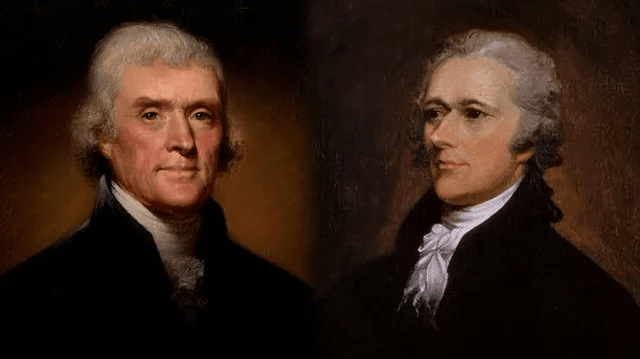
Alexander replied, “A concentrated and centralized power structure, for we are a young nation with new and bold ideas and thus require a clear path forward to implement our brave initiatives.
Thomas told the barkeeper, “A constitutional republic that destabilizes centralized power and distributes it to the people; else the consent of the governed and their concerns shall fall on deaf ears.”
“Hmm,” muttered the barkeeper as he began ruminating on the Hamiltonian and Jeffersonian methods of governance, “looks like we’re in for the long haul,” and reached for the top shelf, where he kept a prized bottle of whiskey that he was saving for just such an occasion.
A man seated across the bar said to Alexander, “Sir, I agree that the swiftest pathway forward in completing initiatives that serve the alleged greater good would be to concentrate power and then to utilize it. But wouldn’t we be risking autocracy or the emergence of the proverbial eight-hundred-pound gorilla with whims?” Next, the man reached into his overcoat and produced a crystal ball. Alexander, Thomas, and the barkeeper gathered around the transparent globe. “Look,” said the man. And the magical sphere transported them to mid-20th-century New York City, where they witnessed urban planner and public official Robert Moses wield the political power he had gained through his chairmanship of the Triborough Bridge Authority. Robert Moses oversaw projects that, although admittedly vital when viewed from a ten-thousand-foot perspective, displaced communities and destroyed neighborhoods.
“Ah-ha,” Thomas guffawed, for he assumed to have gained a worthy advocate.
Meanwhile, Alexander, who saw the revitalization of New York as a winning blueprint and one to inspire all cities to new heights in the future, sagged in his barstool, realizing that concentrated power had run roughshod over so many who would never recover.
Beside the man with the crystal ball sat another, who said to the guffawing Thomas, “Not so fast, Sir. While I do find favor in your concept of a constitutional republic that empowers its people, there shall come a day, in our great nation, when you won’t be able to stick a toothpick in a lawn without first wading through a decade of bureaucratic bungling and special interest thievery.” Next, the man produced a crystal ball of his own. And when the two advocates, Alexander, Thomas, and the barkeeper gathered around, they peered into the magic sphere. They watched as project after project either got derailed because of protests, the numerous palms that required greasing before a divot could be made in the ground, or had run grossly over budget and saw corners cut due to extortionate practices. “Indeed, Sir,” the man said to Thomas, “power to the people could mean too many hands and not enough direction.”
“Sirs,” intoned a woman, also seated at the bar but who had yet to assert herself. She was addressing only Alexander and Thomas, which she managed to make quite clear to the mild chagrin of the other pub patrons and barkeeper. “You are both wise and competent men, as history has suggested,” she said. “Moreover, your respective methods of governance, in theory, are sound but, at times, have fallen short, empirically. So, it would seem that fashioning a hybrid from the two worthy concepts for which you two advocate would be a wise path forward. Indeed, Mister Hamilton, a branch of government, be it federal, state, or local, should hold in reserve the right to mobilize through a concentration of power when the stakes require it, but agree only to wield such power when certain of no collateral damage. Trust me, Sir; the squandering of public trust is a wound that never fully closes.
“And you, Mister Jefferson, are to be commended for penning the Individual Rights of Man; the people should never forget it is they who employ their government. But the people must also understand that there shall come times when the “greater good” will linger on the horizon and that a government and its people must seek and achieve it collaboratively and with compassion. To do so would serve to strengthen any nation’s fiber. So do make haste, Misters Hamilton and Jefferson, to Philadelphia and explain what you have seen and heard and what’s at stake. The future of the Republic depends on you.”
Alexander and Thomas thanked the barkeeper for his “hospitality” and for deeming them worthy of his prized bottle. They also thanked the men who allowed them to glimpse the future. Next, they turned to bid the lady “good day”, but she had gone, vanished. “You’ll thank her for us, won’t you?” came Alexander and Thomas’s humble entreaty to the barkeeper.
“I never saw her before today,” the barkeeper told the statesmen.
“Hmm,” murmured Alexander, Thomas, their respective advocates, and the barkeeper, as they stood bemused over a mysterious woman whose theories on good governance, despite the benefit of history, were remarkable. “Anyway, gentlemen,” said Alexander and Thomas, “we’re off to Philadelphia to rescue the Republic!”


 Michael's Corner
Leave a reply to Michael DeStefano Cancel reply