It was upon a summer’s breeze that the echoes from a forest beckoned a young lass. Often, from the confines of her mother’s garden or with her elbows resting on her bedroom windowsill, she had wondered about the wood just yonder did our golden-haired youth but never had she ventured into its denseness. Today, with trepidation but also imbued with the spirit of adventure, her little feet marched toward the edge of the often-wondered-about woodland domain, paused, and then entered.
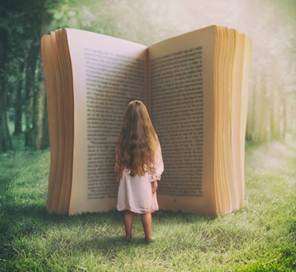
No sooner than the forest enveloped her, she felt decidedly cooler, as the sun, which before had generously kissed her golden mane and delicate shoulders with its summer warmth, filtered sparsely through the canopies of countless treetops. And thus, her innocent eyes widened, taking in all the woodland enchantment there was to behold. A tawny fawn with timorous eyes loped across the path and vanished into the brambled growth between the trees. A golden-billed magpie flew down from an arched bough and flapped one of its wings against her shoulder.
“Is that how you say hello?” she asked.
The little flyer tweeted, circled her head, and then returned to its perch. Then the girl ventured further into the forest and, before long, spotted a young boy. His dark ringleted hair brushed against his shoulders, and his dark eyes gleamed. The girl sensed that the boy, like the fawn and the magpie, was not passing through but had made the forest his domain, and thus she asked him, “What do you do here?” Delighted by her sudden and unexpected appearance, he told her, “I love to play. Please, come and play with me.” And together they ambled about their woodland realm, bound only by the limits of their childlike imaginations. They waved at grinning elves who winked and then hid behind the clustered leaves of a sturdy oak.
Look!” cried the girl, and they began chasing after a sprite, hovering above the forest floor.

The pixie allowed the spirited youths within reach of its wings, then ascended higher. Again and again, it lured the ambitious pair only to drift out of reach. It was a rollicking game they played until the children collapsed in a heap, giggling as only children can. Next, the sprite hovered overhead, the wind from its wings swooshed against the children’s eyelashes, and then it flew away.
The children caught their breath just in time to run from a troll who threatened to steal their youth and beauty in exchange for its age and ugliness, or worse, turn them into statues. And then there were druids and sorcerers weaving spells that turned the tiniest forest dwellers into giant beasts and the tallest trees into an army of dwarves. Deeper into the forest they ventured, encountering winged serpents with breath hotter than a scorching sunbeam, knights of incomparable bravery, and centaurs and unicorns frolicking on a grassy plain. They held hands and played “Ring Around the Rosie” while circling a tree, then ran up the sides of hills singing songs and rolled down the sides of others, their voices distorted by the vibration caused by rolling. They continued until they were too dizzy to stand, near breathless, and exhausted. Next, the sun dipped below the horizon, and dusk settled in the forest; a summer day, chock-full of childlike adventure and enchantment, was slipping away. The young girl lay gazing up at the darkening sky, remembering how the day had begun and how her curious nature had overcome fear, leading to a day of unparalleled delight. She turned to thank the young boy, but he had gone, vanished. She shuddered, thinking that the fawn, magpie, elves, sprite, and the companion with whom she had shared a day of many wonders was all but a fanciful dream.
She returned to the forest’s main pathway and turned westward, but not even a faded outline of her home was discernible. The woodland creatures of the night bade her, “Follow the moon, dear child,” and thus, undaunted, she walked deeper into the forest. With each step, she felt herself surging from within and sensed a new paradigm had overtaken her façade. She pressed onward through the night, with no memory of her legs faltering or her body settling into the soft grass of a moonlit meadow. She woke soaked in dew; the early morning rays stung her eyes. Scanning the meadow, she noticed the creatures of the night were presently at rest, and the day shift had begun. Her old friend, the golden-billed magpie, tweeted, “Good morning,” and then gushed, “My, how you’ve grown!”
Across the meadow, she spotted a boy. He hadn’t a plan for his dark, tufty tresses, but his dark eyes gleamed with inquisitiveness and intelligence. She approached the boy and asked him, “What do you do here?” and the boy replied, “I am always discovering new things. Come and discover with me.”
And off they ventured into the world and its many wonders, armed with a thirst for knowledge and a curiosity so insatiable it was matched only by the desire to learn together. They stood before the Fountain of Youth, thought to have been discovered by Spanish explorer and conquistador Ponce de Leon, and dared one another to drink its waters.

The boy, who nearly succumbed to temptation, said, “Ne; let us return with our cups when we have acquired sufficient wisdom.” The girl agreed that the dawn of pubescence was not a wise time to remain frozen in time.
“You are right,” she told her companion. “We mustn’t remain nascents forever.”
And thus they explored the world’s ancient empires, the Greek and the Roman, and sat at the feet of Pythagoras and Cicero, learning the theories of space and proportion, as well as the importance of statesmanship and philosophy. They stood on the shores of Greenland, awaiting Eric the Red, and sailed a strait named for Ferdinand Magellan on a ship called Victoria. They studied Copernicus’s once blasphemous theory that the Earth and its neighboring planets revolved around the sun, and marveled at the wonder of the firmament, peering through Galileo’s telescope. Lastly, they arrived in a place once dubbed “The New World,” where a man using a kite and key discovered electricity, and revolution and innovation launched a new way of governance. And still their thirst for knowledge and enlightenment remained robust. But the daylight was fading; the night came fast.
“Where did you go?” the girl cried out to her companion. The boy, like the child before, had gone, and she, with all her newly acquired knowledge, was left to ramble the forest alone. She missed her mother and wondered about her home, but was urged onward, deeper into the forest, by the nocturnal inhabitants of the wood. As she trudged through the darkest hours, like a flower whose tight bud began to open, she could feel her shape blossoming. And then the Earth turned. Before long, she felt the sun’s warmth on her face, and when she opened her eyes, from across a meadow whose dew had already dried, she spotted a young man, ruddy of complexion and sinewy of form. Intuiting her now fully unfurled blossom exuded charms too alluring to resist, she approached the young man with decorum and confidence, a manner oddly contradictory, and asked, “What do you do here?” Beguilingly, he replied, “I burst with love. Come fall in love with me,” and she latched onto his outstretched hand, and together they ambled over sundrenched fields of green, were enchanted by every echo when immersed in their woodland cathedral, and dipped their feet in the calm waters of a nearby pond as they spoke the language of Keats and Byron.

“I shall know no other but you,” he breathlessly told her.
“Nor shall I know another, my true love,” came her impassioned reply.
And thus, they took their pledge into a world of wearing influences. Instead of wavering, their bond grew more fibrous. And when their tangled bodies soared to the pinnacle of intimacy, there were moments of idyllic splendor that surpassed all that was once foretold and imagined, for to know one another’s skin was to peek into Heaven.
Come the end of the day, the young woman watched her lover as he gathered wood for a crackling fire. She rushed to lend a hand but found herself, in the dimness of twilight, standing alone. Her lover, as did the boy who once beamed with a lust for knowledge, had disappeared. But she did not feel forsaken. She understood that she was Penelope to his Odysseus, Jane Eyre to his Rochester, Eurydice to his Orpheus, and was confident the guiding forces of fate would see them reunite in a sundrenched meadow upon her nocturnal journey through the forest’s central corridor.
And there he stood, a man bound by the present with an eye on the future, and she said to him, “What do you do here?” He told her, “I am driven to build. Come and build with me.”
No sooner than he guided her over a threshold, they found themselves frothing with love as they peered down at a cradle-lain infant; the child would be their first of three.

And as he worked the land to draw forth the richness of its bounty, she healed the sick and cared for the wounded. Come the evenings, once the children were ushered off to bed, they sat by the hearth, sipped tea, and counted their blessings, for their story was one steeped in true love, written with the help of a loving God, amid a madding world. And there were summers at the seashore and Christmases at Grandma Elizabeth’s, who each year crooned, “My, how the children have grown.”
“And they’re devoted to their studies and strong enough to help their father in the field,” the children’s mother told Grandma Elizabeth.
On marched the seasons—their inexorable procession bringing growth, change, and adversities that stretched their already boundless love—including one that saw her nurse him through a bout of typhus just in time for the harvest that supplied a Thanksgiving feast. And then, one by one, the children sprouted wings that took them into the world.
“We need to lengthen our table and supply more food for our celebrations of gratitude,” she told him. And right away, he fashioned a leaf to accommodate the fronds from their tree of life, and cultivated for a more robust yield.
“Well done,” she said, and opened her arms wide and inhaled deeply to envelop and breathe in all the fruit of love’s labor. Come the evening, she went to the kitchen to boil water for tea. When she returned to the hearth with a kettle and two cups, she discovered he had gone. She stared into the fire, at first with fraughtness, then with benevolence, for life had not betrayed her; it moved on. The fire began to fade until it disappeared. She felt a nip in the air as her feet crunched the season’s spent leaves. In the autumn of her years, the forest was far less dense than it was when she entered in childhood. She trudged onward from dusk until dawn. In the distance, the morning light set ablaze a cabin toward the end of the corridor. On the porch, she spotted an old man rocking and said, “Excuse me, sir; what do you do here?”
He looked past her aged face and into the light that still beamed in her eyes, and he replied, “I am always remembering. Please sit and remember with me.”
As she reached for his hand, she saw a young lass bursting with wonder as the wind blew through the dark ringlets of a woodland lad. And then there they stood, ambitious youths, thirsting for knowledge, absorbing the wisdom of sages and philosophers, and the facts of science and mathematics. And how they rejoiced in the thrall of romantic love and all that flowered from their indestructible bond. On and on the memories floated past them; there were so many to sort, to embrace, to savor. But come the morning, she woke and rocked beside an empty chair. She looked east into the light at the end of the woodland corridor.

Just as the echoes of a forest once beckoned a young lass, the light compelled her. And thus she marched, a humble servant, resolutely toward the luminous end of an unforgettable journey. Alit at the threshold, she saw a hand amid the glow. She reached for it, grasped it, and the hand guided her to a lofty dominion from which flowers humanity’s conscience. And then they fell on their knees, did these children of enchantment, of knowledge, of love, of faith, of duty, and of family, and cried, “Dear God, in all Your mercy, we have walked Your corridor to its eternal light and we are home.”
 Michael's Corner
Leave a comment